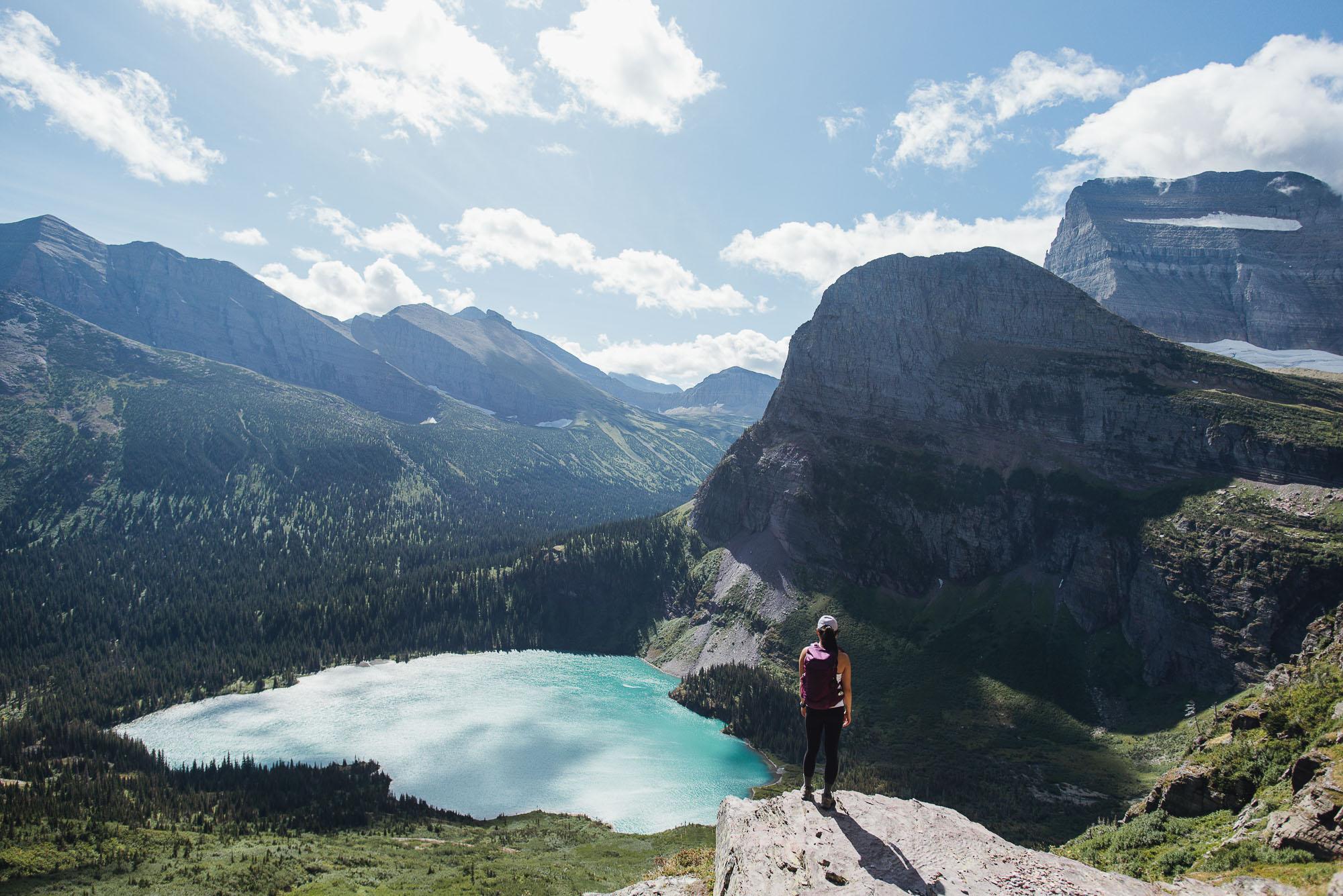
Photography and ultralight backpacking don’t exactly go well together.
Camera gear is heavy. Take my setup, for example: 1 camera and 2 lenses adds up to 3 pounds. That’s much lighter than a typical landscape photography kit that might weigh closer to 10 pounds and include a tripod. But, it’s significant when you’re an ounce-counting ultralight backpacker (check out my guide to ultralight backpacking).
For most backpackers, the best ultralight photography gear would be your phone camera. If you landed on this post though, chances are you want the experience of using an actual camera and to publish your photos beyond just mobile.
In this post, I’m going to talk about my camera setup from the perspective of a hiker and backpacker. This includes tradeoffs to keeping my kit as ultralight backpacking-friendly as possible, and my favorite ways to carry a camera while hiking. Whether you’re a hiker or simply someone looking for lightweight camera gear recommendations, this post is for you!
Note: This post contains affiliate links. Using them for a purchase supports my blog at no extra cost to you. Thanks for your support!
My Gear
Body: Fujifilm X-T30 (13.4 oz/380 g, Amazon)
Wide-angle lens: Fujifilm 10-24mm f4 (13.6 oz/385 g, Amazon)
Mid-range lens: Sigma 18-50mm f2.8 (10.1 oz/285 g, Amazon)
Telephoto lens: 50-230mm f4.5-6.7 (13 oz/369 g, Amazon)
Weight (1 camera + mid-range + telephoto): 2 lbs 4 oz/1,034 g
I usually only bring 2 lenses on a backpacking trip, and have recently been choosing the Sigma over the wider Fujifilm 10-24mm.
Carry/protection:
Peak Design Capture camera clip V3 (3.1 oz/89 g, link)
Chicken Tramper 1L Fanny Pack (4.6 oz/130 g, link)
From Nikon to Fujifilm
Before I switched to Fujifilm, I had a full-frame, DSLR Nikon setup which weighed 5 pounds. Backpacking with my camera gear was a chore. I barely used my telephoto lens (the nearly 2 pound Nikon 70-200mm f4, in case you’re curious) while hiking because I had to take off my pack to access it. When I traveled in cities, I often left my camera in my hotel room because it was too heavy to walk all day with it.
Now, my Fujifilm setup is 3 pounds. Fujifilm specializes in mirrorless, APS-C (crop-sensor) cameras. APS-C has a huge size and weight advantage over full-frame. Even though my Fujifilm kit would be outperformed by my old full-frame kit in low-light situations, the vast majority of the time, the photos are good enough. Any tradeoffs are far outweighed by my gear’s portability, which make me want to pick up my camera more and enjoy photography again. I have no regrets!

Switching Camera Systems
Switching camera systems is quite a hassle since it means buying everything from scratch.
Here are some of my takeaways from my experiencing switching from full-frame DSLR to crop-sensor mirrorless.
- Lenses first. My requirement for a lightweight telephoto zoom eliminated some brands entirely and was a big reason I went with Fujifilm.
- Downsizing to APS-C AND mirrorless made my setup much lighter. If I wasn’t willing to give up full-frame, I would have only saved 400-500 g (see my potential setups) off my DSLR setup. That difference wasn’t large enough for me to justify buying new gear.
- Camera weight and pack weight are not created the same. The difference in comfort is much larger when the weight is outside your pack, like when wearing the camera on a Peak Design clip on a shoulder strap. Having a lighter camera is also nice for:
- Wearing the camera on a camera strap, which I often do when I’m traveling in cities.
- Being less physically fatiguing to use (maybe I just need stronger arms).
- Size matters. Smaller lenses means I have the option to store my second lens in a fanny pack rather than in my pack where it’s basically inaccessible while hiking.
Body
What I use
Fujifilm’s X-T30 (13.4 oz/380 g)
The main Fujifilm cameras are the single-digit models (X-T3, X-T4, X-T5) and the smaller, double-digit models (X-T20, X-T30, X-T30 ii). Both series share the same sensors and processors, which means identical image quality. However, the smaller models sacrifice some features for their compactness, including:
- Single (vs dual) memory card slot
- Smaller, lower-resolution EVF
- No Fujifilm WR label (weather-resistance)
- No grip, so some people may find it awkward to hold
- Tilt screen instead of a fully articulating screen
The X-T30 was the winner for me despite these sacrifices. If you’re having trouble deciding, I would highly recommend seeing the cameras in a store.
Alternatives
I researched other popular Fujifilm bodies like the X-E3, X Pro 3, X-S10, but I ended up passing on them for a variety of reasons including price, availability, and added weight for features I didn’t value.
Wide-Angle Lens
Every landscape photographer probably has a wide-angle lens in their kit. Wide-angle lenses are good for capturing panoramic views and creating unique juxtapositions of foreground and background.
Wide-Angle Prime vs Zoom
Are you torn between getting a wide-angle prime or a wide-angle zoom?
If you are really trying to optimize for weight, primes are the choice for you. They are lighter and faster than their zoom counterparts. I loved using my Nikon 20mm f1.8 before I switched to Fujifilm. I shot handheld with it even at sunset and sunrise, and it was wide enough for astrophotography.
The downside of primes for landscape photography is that compositions are limited when there’s just no space to zoom with your feet, as is often the case in nature (edge of a cliff, edge of a lake, narrow hiking trail, etc.).
While wide-angle zooms are heavier and not as fast, the dramatic perspective difference in this focal range (usually between 10 and 35 mm), make them a versatile choice for landscape photography.

What I Use
Fujifilm 10-24mm f4 (13.6 oz/385 g)
Fujifilm’s premier wide-angle zoom is sturdily built, and relatively compact and lightweight. It’s a 15-36 mm full-frame equivalent and covers a really usable focal range. The downside is it’s not fast enough for astrophotography.
Alternatives
- Fujifilm 14mm f2.8 (233 g): a well-loved lens for landscape photography. The fast maximum aperture and 21 mm full-frame equivalent focal length make it a versatile choice.
- Fujifilm 16mm f2.8 (155 g): compact prime. It can be a bit narrow for a landscape lens (24 mm full-frame equivalent)
- Fujifilm 16mm f1.4 (375 g): faster but heavier version of the 16mm f2.8
- Viltrox 13mm f1.4 (420 g): not very light for a prime, but a faster choice than the 14mm f2.8.

Shot at 24 mm (36 mm full-frame equivalent)
Mid-Range Lens
Photographers often refer to the “holy trinity” lens kit as a wide-angle zoom, a mid-range zoom, and a telephoto zoom. I limit myself to 2 lenses since I’m prioritizing weight, and I have recently found myself gravitating towards my mid-range Sigma 18-50mm f2.8 over my Fujifilm 10-24mm f4.
I primarily take photos on-the-go while hiking with little time for composition, and the mid-range focal lengths make that easiest for me. On the other hand, I think traditional landscape photographers may find the wide end of mid-range zooms to not be wide enough, and in turn limiting for creative composition (I like Andy Mumford’s YouTube video on this topic).
What I use
Sigma 18-50mm f2.8 (10.1 oz/285 g)
This lens is small, light, and has a constant 2.8 aperture. If I wanted to travel as light as possible and ONLY carry one lens, it’s this lens.
Alternatives
- Fujifilm 16-50mm f2.8-4.8 (8.5 oz/240 g): successor to the beloved 18-55mm kit lens with internal zoom
- (Older version) Fujifilm 18-55mm f2.8-4 (10.9 oz/309 g): a capable and lightweight kit lens
- Fujifilm 16-80mm f4 (15.5 oz/440 g): pretty compact, do-it-all lens for its zoom range.
- Fujifilm 18-120mm f4 (16.2 oz/460 g): another do-it-all lens, and an impressive weight!
- Fujifilm 16-50mm f3-5.5.6 (6.9 oz/195 g): the smallest and lightest of the bunch, but also the slowest lens. XC build quality.
Telephoto Lens
Sometimes there might only be one way to capture a landscape with a wide-angle lens when there’s no interesting foreground. With a telephoto, I have so many more options for composition. I can explore a more abstract side of landscape photography by isolating lines, patterns, and shapes. And while I’m not a dedicated wildlife photographer, it is super fun to be able to get decent photos of the occasional wildlife that I see while backpacking.

What I use
Fujifilm 50-230mm f4-6.7 (13 oz/369 g)
This lens is part of the XC line of lenses. Fujifilm describes XC lenses as “compact and casual”, but I joke that it stands for “X-tra Cheap” as they have predominantly plastic builds. But the optical performance is far from cheap, and the lens is astoundingly lightweight. Its small size also allows it to fit in a fanny pack while I’m hiking. This is not easy to find in a telephoto zoom lens, and is a large reason I chose Fujifilm.

Shot at 230 mm (345 mm full-frame equivalent)
Alternatives
- Fujifilm 55-200mm f4 (20 oz/567 g): this lens is Fujifilm’s flagship telephoto zoom. It has a few more stops of light on the long end and it’s made of metal.
- Fujifilm 70-300mm f4-5.6 (21 oz/588 g)
Carry and Protection
Bringing a camera hiking is useless if it’s not easy to access while hiking. I’ve tried both the Peak Design Capture camera clip and the Hyperlite Mountain Gear camera pod. The Peak Design clip has a slight edge for me because it’s more versatile and works on any backpack, but the camera pod offers more protection.
1: Peak Design camera clip + fanny pack

The Peak Design Capture camera clip (3 oz) has 2 pieces: a mounting bracket and a plate that screws on to the camera’s tripod mounting screw and slides into the mounting bracket. The mounting bracket is most popularly attached to the shoulder strap, and it makes the camera very easy to access while hiking.

I use the Chicken Tramper 1L fanny pack (4.6 oz) to hold my second lens. This fanny pack is ultralight and moderately waterproof thanks to the X-Pac fabric. You can order an off-the-shelf fanny pack here or design your own custom color one here (which I did!). A more spacious fanny pack would be the Summit Bum Classic (3.5 oz) which also uses ultralight, waterproof fabric, or the larger Chicken Tramper 2.5L fanny pack (5.2 oz).
Pros:
- It’s so convenient. I can unclip my camera and re-clip it without stopping and without looking at it.
- My extra lens is always accessible, even when I remove my backpack. It’s nice to take my pack off to take a break but still be able to walk around with my camera in my hand and my extra lens in my fanny pack.
- Minimal extra bulk compared to padded camera bags.
Cons:
- No protection from weather or impact. One annoying consequence of having my camera clipped to my shoulder strap is that I need to be careful when I take my pack off so that my camera doesn’t swing and hit something. Rain protection isn’t a huge con for me; I wrap a plastic produce bag or a shower cap around my camera which works pretty well.
- Can be uncomfortable with heavier cameras due to the uneven distribution of weight, especially when backpack straps are thin.
- The Peak Design camera clip is not wide enough for some backpacking pack straps and may take some finicking to put on.
2: Hyperlite Mountain Gear Camera Pod
The Hyperlite Mountain Gear camera pod (2.8 oz small, 3.7 oz large) is a structured, lightly-padded bag that attaches to the outside of a backpack.

I have the large size since I originally bought it for my full-frame Nikon D750. After switching to the Fujifilm X-T30, the large fits my camera with a lens attached AND my additional lens. I use a square of foam from Gossamer Gear’s thin light pad as padding between them. Having my camera and additional lens in the same place makes switching lenses super convenient.
Pros:
- My camera is always protected. I don’t have to worry about it when scrambling or when putting my pack down on the ground. I don’t need to put my camera away in the rain. It also makes lens caps unnecessary, so going from storage to shooting is even faster.
- The one hand operated zipper makes it easy to get my camera out.
- The cord handle is nice for carrying my gear short distances, for example around camp.
Cons:
- It’s bulky. Because I attach it near the hip, the bag can get in the way in narrow spots. I know others attach it to the chest/sternum strap, although I prefer not to because it blocks my view of my feet.
- The dyneema lining is not very abrasion-resistant. Taking my camera in and out constantly has worn down the lining and the dyneema fibers are starting to shred.
What I Leave at Home
I’m a backpacker first and a photographer second. A lot of these items are just not worth the weight for me given my style of photography, which is mostly taking quick photos throughout the day while I’m hiking.
Tripod - If I really want to do low-light or astrophotography, I might just improvise a tripod with some rocks.
Camera strap - I only use a wrist strap with my camera. While I’m hiking, my camera stays on my Peak Design clip.
Camera filters - I do think a polarizer would be useful and not a huge weight penalty, but I don’t want to have to worry about losing or breaking it.
More than 2 lenses - A wide-angle lens and a telephoto lens covers the range I need for landscape photography most of the time.
Sony, Nikon, and Canon Alternatives
Weight was my #1 priority so Fujifilm won me over at only 40 oz (1134 g). But if you’re set on full-frame and/or are loyal to Sony, Nikon, or Canon, I still have lightweight picks for you! I highlighted what my likely setup would be for each brand.
You might be wondering: why not an APS-C setup from Sony, Nikon, or Canon? They are definitely valid options, but my opinion is that if you’re going with APS-C, go with Fujifilm. Fujifilm has a more robust APS-C lens lineup compared to these brands where APS-C is a second-class citizen.
Sony
| Bodies | |
| A7C ii | 18.1 oz / 514 g |
| A7iii or A7iv | 22.9 oz / 650 g |
| Wide-Angle Lenses | |
| Sony FE PZ 16-35mm f4 | 12.5 oz / 353 g |
| Sony FE 20mm f1.8 G | 13.2 oz / 373 g |
| Sigma 16-28mm f2.8 | 15.9 oz / 450 g |
| Sony FE 16-35mm f2.8 GM II | 19.3 oz / 547 g |
| Telephoto Lenses | |
| Tamron 70-300mm f4.5-6.3 | 19.2 oz / 545 g |
| Tamron 28-200mm f2.8-5.6 | 20.3 oz / 575 g |
| Sony FE 70-200mm f4 | 28.0 oz / 794 g |
| Midrange Lenses | |
| Sony FE 20-70mm f4 | 17.2 oz / 488 g |
| Sigma 28-70mm f2.8 | 16.6 oz / 470 g |
| Sony FE 28-70mm f3.5-5.6 | 10.4 oz / 295 g |
| Selected setup (1 camera + 2 lenses) | 3.2 lbs / 1,462 g |
My take: This is the lightest of the 3 full-frame kits I created. Sony offers the A7C as a compact body with the same sensor as the A7iii/A7iv, and has good lightweight options for both a wide-angle prime and zoom. Pair a wide-angle with the 28-200mm superzoom for better mid-range coverage, or the Tamron 70-300mm for more reach. The Sony 20-70mm would also be a good pairing for the telephoto zooms that start at 70mm.
Nikon
| Bodies | |
| Z 6ii | 24.9 oz / 705 g |
| Z 7ii | 24.9 oz / 705 g |
| Wide-Angle Lenses | |
| Nikon Z 14-30mm f4 | 16.9 oz / 479 g |
| Nikon Z 17-28mm f2.8 | 15.9 oz / 450 g |
| Nikon Z 20mm f1.8 | 17.7 oz / 503 g |
| Telephoto Lenses | |
| Tamron 70-300mm f4.5-6.3 | 19.2 oz / 545 g |
| Nikon Z 24-200mm f4-6.3 | 19.9 oz / 565 g |
| Midrange Lenses | |
| Tamron 28-75mm f2.8 (new) | 19.4 oz / 550 g |
| Nikon Z 28-75mm f2.8 | 19.9 oz / 565 g |
| Nikon Z 24-120mm f4 | 22.2 oz / 630 g |
| Selected setup (1 camera + 2 lenses) | 3.7 lbs / 1,700 g |
My take: You can achieve a decently lightweight Nikon kit by choosing the 24-200mm superzoom as your only lens. If you’re going for a 2 lens setup, the Tamron 70-300mm is an attractive option for a relatively portable telephoto zoom.
Canon
| Bodies | |
| EOS RP | 17.1 oz / 485 g |
| EOS R | 23.3 oz / 660 g |
| EOS R6 | 24.0 oz / 680 g |
| EOS R5 | 26.0 oz / 738 g |
| Wide-Angle Lenses | |
| Canon 15-30mm f4.5-6.3 | 13.6 oz / 384 g |
| Canon 14-35mm f4 | 19.0 oz / 538 g |
| Telephoto Lenses | |
| Canon 70-200mm f4 | 24.3 oz / 688 g |
| Midrange Lenses | |
| Canon 24-105mm f4 | 24.7 oz / 700 g |
| Canon 24-70mm f2.8 | 31.8 oz / 900 g |
| Selected setup (1 camera + 2 lenses) | 4.2 lbs / 1,886 g |
My take: Canon’s lightweight wide-angle lens offerings are scarce, and the lightweight telephoto options are nonexistent. Some people also use EF (non-mirrorless) lenses with the RF cameras, but EF lenses are generally bulkier and the required adapter weighs an additional 3.9 oz/110 g.
loading comments...